
What is ADAPT?

My work with businesses and organisations is based on the ADAPT Programme – Agile Development and Psychological Training – developed on the ground during the war in Ukraine.

It is a comprehensive support framework combining psychological support, training and organisational development, helping organisations respond to crisis situations through a flexible, adaptive approach.

ADAPT, recognising that success in a crisis requires both individual wellbeing and organisational coherence, offers tailored interventions that integrate

  • psychological support for individuals,
  • work with leadership teams and
  • group educational formats, adapting in real time to changing needs.  

The approach evolves with changing demands, emphasising continuous learning and adaptation.

Developed in wartime, ADAPT is designed for any organisation under sustained pressure: restructuring, economic crisis, leadership strain or chronic uncertainty.

It will guide your business through disruption, upheaval and the severe mental strain affecting teams and operations.

To discuss how ADAPT could work in your organisation, please contact me.

How I work with organisations

Most psychological support offered to organisations falls into a familiar pattern.

  • It happens to individuals, in isolation, after something has gone wrong.
  • A staff member burns out and is offered an app.
  • A leader is given coaching.
  • A team is sent on a resilience workshop.
Each of these can help.
None of these changes how the organisation actually functions under pressure.
My work starts from a different premise.
The strain people carry at work is rarely just personal. It moves through the system: across teams, between leaders and staff, between work and home, between what people say and what they hold privately.
If the system stays the same, individual interventions can only do so much.
I work with the whole picture.

Three layers, working together

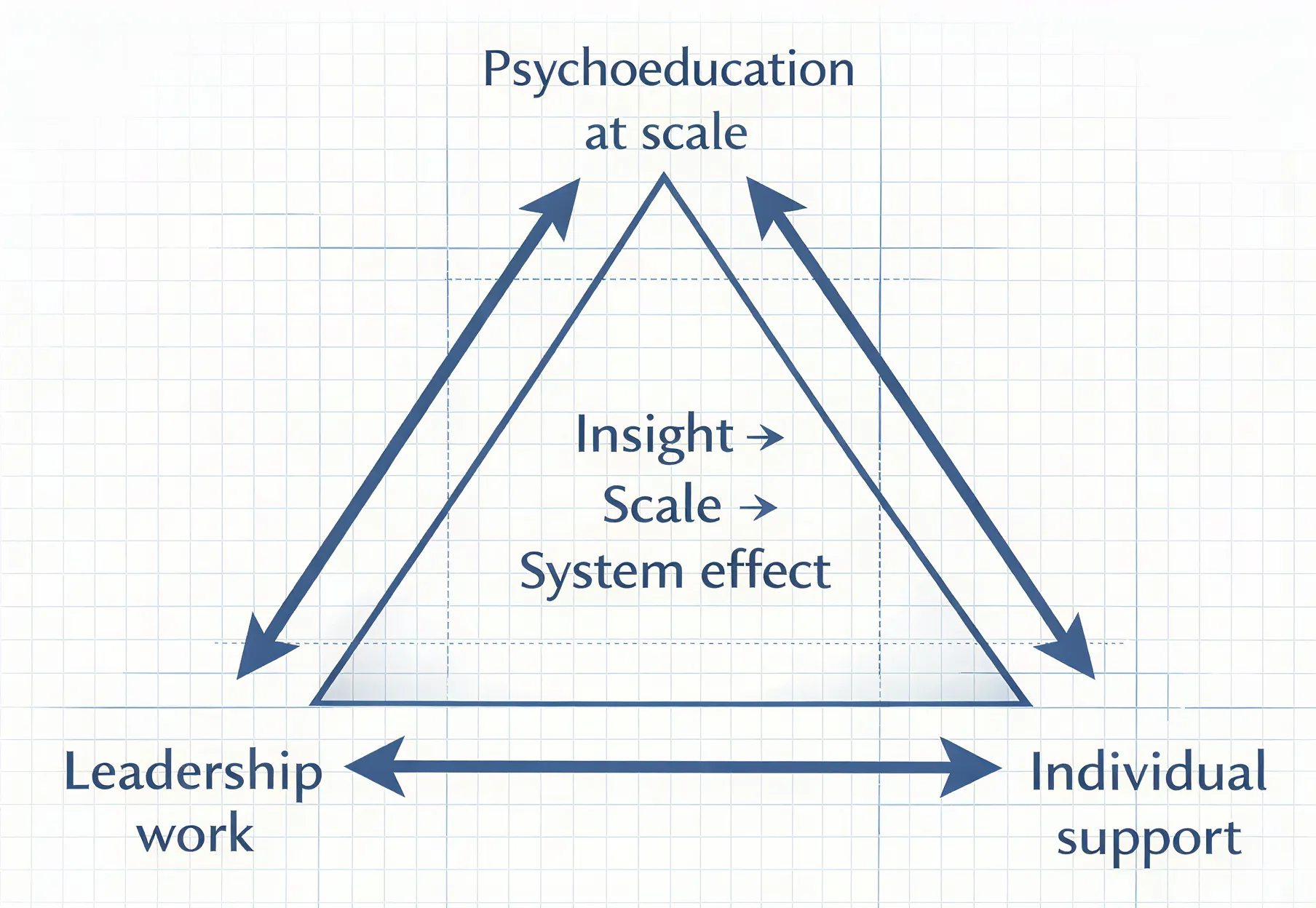
Most engagements combine three kinds of work. They can be commissioned separately but the value compounds when they run alongside each other.
Group work
Webinars, workshops, and written or recorded resources designed around the realities people are facing.
Rather than addressing issues one person at a time, these interventions create a shared understanding of pressure, transition, uncertainty, conflict, loss and recovery. The aim is to equip people with a common language and practical tools, enabling teams to recognise challenges earlier, respond more effectively and support one another under pressure.
Leadership support
Individual sessions or small group work with the people carrying the most weight. Senior leaders, partners, founders, heads of function. Often the hardest hit and the least likely to seek support. This work focuses both on their own capacity to function under pressure and on the demands they carry on behalf of their teams and the wider organisation.
Individual sessions
Confidential one-to-one support available to staff who need it. Some sessions are short and practical. Others involve deeper therapeutic work.

One Integrated System

What makes the approach distinctive is the integration between all three layers.

The same practitioner works across them, creating continuity and ensuring that issues emerging in one part of the system can be understood and addressed within the wider context. What emerges is a continuous feedback loop between leadership, teams and individuals.
  • Leadership conversations reveal strategic pressures, emerging risks and patterns across the organisation.
  • Team work shows how these pressures are affecting communication, relationships and day-to-day performance.
  • Individual support provides insight into how the organisational environment is being experienced on the ground. er is given coaching.
Each layer informs the work at the others, making it possible to respond earlier and more precisely Recurring themes are explored and tested across the organisation so that support can adapt as circumstances change.

Formats

Engagements take different shapes depending on what an organisation needs.

Artwork by Mariya Prymachenko
Focused intervention
One to four sessions. Useful when there is a specific issue to address: a restructure, a sudden loss, a difficult transition, a team in conflict, a leadership team that needs a contained space to think. Can be a workshop, a contribution to an offsite, or a short series of leadership conversations.
Diagnostic engagement
Roughly three months. Used when an organisation senses something is wrong but has not yet named it clearly. Combines leadership conversations, a small number of individual sessions, and a short written assessment. Often becomes the foundation for ongoing work, but can also stand alone.
Embedded support
Six to twelve months or longer. The fullest expression of the approach. All three layers running together, evolving with the organisation. Best suited to environments under sustained pressure or going through significant change.

Why choose ADAPT?

There are other places to take this kind of work. It is worth being clear about the difference.

Generic wellbeing providers and digital platforms offer scale and accessibility. An app on every phone, a helpline number, a library of resources. For some staff and some moments, this is enough. What it cannot do is engage with how a specific organisation actually functions, recognise patterns particular to your team, or hold the weight of serious psychological work.
Executive coaches offer focused individual work, often skilled and useful. The limit is depth and scope. Most coaching is bounded by what is coachable: performance, behaviour, goals. It rarely reaches the clinical material underneath, and it almost never engages the system around the individual. A coach works with one person at a time. I work with the person and the field they are in.
The people-and-culture practices of larger consultancies bring resources, frameworks and the reassurance of a recognised brand. What they do not typically offer is clinical depth, sustained presence, or the kind of trusted relationship in which people feel able to speak openly about what is really happening. Their work is usually delivered through projects and teams. This is different from working with a single practitioner who develops a deep understanding of the organisation over time.
My work combines three elements that rarely sit together:
  • Clinical depth
  • Systemic thinking
  • Turning complex psychological realities into shared understanding, practical tools and effective ways of working together
I tested this approach for over four years of working with organisations in wartime conditions, which left little room for theory. Every intervention had to prove its value in practice. What I learned there now informs my work with organisations facing less extreme, but still chronic, pressure.

What ADAPT Brings

Direct crisis experience
Four years of wartime organisational support
Approaches tested under sustained pressure and prolonged threat
Working knowledge of trauma in professional settings
Experience with local, distributed and displaced teams
Integrated perspective
Psychology, psychoeducation and organisational development
Support for leaders, teams and individuals
Immediate response and long-term resilience
Grounded in reality
Built for chronic uncertainty
Practical, usable and relevant
Supporting people while strengthening organisations
Cultural bridge
International insight with UK professional standards
Multilingual communication across cultures

If your organisation is asking serious questions about what your people are carrying and the standard answers feel insufficient, this approach may be what you are looking for.